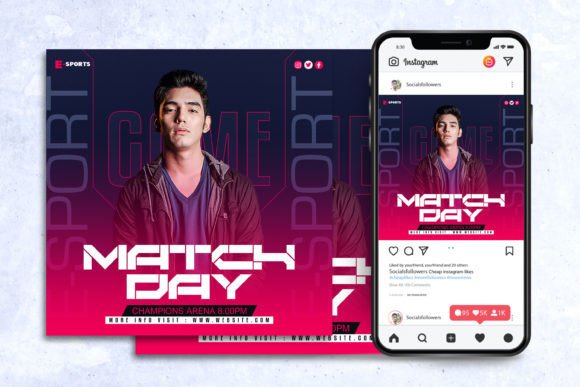
Choosing the Right Visual Template for E-Sports Social Media Marketing
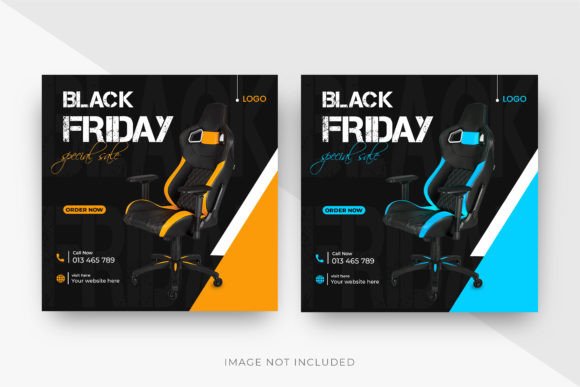
In the high-stakes, fast-paced world of E-Sports marketing, a social media post is more than just an announcement; it's a strategic visual asset. For teams, tournament organizers, content creators, and game publishers, these posts serve as critical touchpoints for fan engagement, brand reinforcement, and community building. Unlike generic social media templates, an E-Sports Gaming Social Media Post design is engineered for this specific ecosystem, balancing aesthetic appeal with functional clarity. This specialized template, typically offered as a 1080x1080 pixel, 300 DPI Adobe Photoshop file in RGB color, represents a foundational tool for digital marketing in gaming.
What Distinguishes an E-Sports Social Media Template?
The core distinction lies in its intentional design for the gaming audience and platform constraints. A standard social media graphic might prioritize minimalism or broad commercial appeal. An E-Sports Gaming Social Media Post template, however, integrates visual elements that resonate immediately with gamers. This includes dynamic layouts that can accommodate team logos, player stats, tournament brackets, or bold typography suited for match results or event hype. The RGB color profile is essential, as it ensures vibrant, screen-accurate colors that won't appear dull or washed out on digital displays—a common pitfall when using CMYK-oriented designs for web use.
The practical utility is heightened by its structure. With all main text elements being editable, marketers can rapidly adapt the template for multiple purposes: a victory announcement, a schedule update, a roster change, or a partnership reveal. The specified 300 DPI resolution for a web-ready graphic is somewhat nuanced. While 300 DPI is a standard for print quality, its use here generally indicates the file is built at a high-resolution baseline, ensuring that when scaled to the 1080x1080 pixel Instagram or Facebook post size, the image remains crisp and free of pixelation. This is a mark of professional-grade asset preparation.
Comparing Template Formats and Approaches
When evaluating resources for creating E-Sports social content, professionals typically weigh several formats. The dedicated Adobe Photoshop (.PSD) template, as described, sits alongside alternative approaches like using online drag-and-drop design tools (e.g., Canva), commissioning custom illustrations for each post, or employing simplified graphic presets within video editing software.
The Photoshop template offers a significant degree of control and brand consistency. For organizations with established color schemes, fonts, and visual identity, having a master file where these elements can be precisely managed is invaluable. The tradeoff is the requirement for software access and at least intermediate design skills. Conversely, online design platforms provide ease of use and speed, often with pre-set gaming-themed elements. Their strength is in democratizing design, but the tradeoff can be a more generic look, limitations in fine-tuning, and potential challenges in maintaining absolute brand uniformity across a campaign.
Another consideration is the static versus dynamic content spectrum. The E-Sports Gaming Social Media Post template discussed is inherently for static image posts. For many announcements, this is perfectly sufficient. However, the modern social media landscape also favors short-form video and animated graphics. A comprehensive strategy might therefore pair a library of static PSD templates with tools for creating motion graphics, recognizing that each format serves a different engagement purpose.
Strengths and Specific Use Cases
The primary strength of a professionally crafted, editable Photoshop template is efficiency within a branded framework. Once the master file is set up with correct layers, a marketing team can produce a week's worth of coordinated posts in a fraction of the time it would take to design each from scratch. This is particularly beneficial for E-Sports entities that operate on tight timelines aligned with match days, patch releases, or content drops.
This approach is a best-fit for:
- Teams and Organizations with Recurring Post Types: If you consistently need to post match results, player highlights, or merchandise launches, a template ensures visual coherence.
- Marketers with Photoshop Proficiency: The value is fully unlocked when the user can comfortably navigate layer styles, text editing, and export settings.
- Projects Prioritizing Brand Precision: When exact logo placement, official hex colors, and licensed fonts are non-negotiable, a customizable PSD file is often the only viable option.
Limitations and Decision Factors
It's crucial to recognize where this specific resource might not be the optimal choice. The template explicitly states "Image Model Not Included," meaning any central hero image or player photograph must be sourced separately. This separates it from more all-inclusive graphic services. Furthermore, its fixed 1080x1080 dimension is ideal for square-format platforms like Instagram posts, but may require adaptation for Facebook cover images, Twitter headers, or YouTube channel art.
Key decision factors when considering an E-Sports Gaming Social Media Post template include:
- Team Skill Set: Do you have in-house or freelance access to Adobe Photoshop CC? Without it, the file is unusable.
- Content Volume and Variety: If you need only a few, highly unique graphics per month, a custom design per project might yield more creative impact. High volume and repetitive structure favor the template.
- Multichannel Needs: Consider if your strategy relies solely on square image posts, or if you need assets for multiple formats and aspect ratios.
When to Choose This Template and When to Seek Alternatives
The E-Sports Gaming Social Media Post Photoshop template is likely the right choice when your operations are built on consistency, speed, and brand control. For a league publishing daily standings, or a team announcing weekly content, it becomes a workflow cornerstone. It allows for maintaining a professional visual standard that fans recognize, which in turn builds brand authority and trust—a principle aligned with Google's E-E-A-T (Experience, Expertise, Authoritativeness, Trustworthiness) framework for content.
However, you may need another option in several realistic scenarios. If your social strategy is heavily tilted toward video content (e.g., clip highlights, behind-the-scenes reels), investing primarily in static image templates might misallocate resources. Similarly, for individuals or small content creators starting out, the cost and learning curve of Adobe Photoshop might be prohibitive. In such cases, beginning with a versatile online design tool that offers gaming-themed templates can be a more practical initial step.
Another alternative path emerges if your needs are highly bespoke. Some organizations prefer to have a graphic designer create wholly original art for each major campaign. This sacrifices efficiency for maximum creative impact and is a valid approach for landmark announcements like a championship win or a major partnership.
Making an Informed Resource Selection
Evaluating an E-Sports Gaming Social Media Post template, or any similar design resource, ultimately comes down to auditing your internal capabilities, content calendar, and brand guidelines. A practical comparison involves listing your most frequent post types and estimating the time spent creating them currently. If a template can standardize 70% of that output, the efficiency gain is clear.
Remember that a template is a tool, not a strategy. Its success depends on how it's integrated with your content planning, copywriting, and community management. A beautifully designed post about a tournament is ineffective if the tournament details are incorrect or the posting schedule is off. Therefore, the most informed decision views this design resource as one component in a broader, user-focused marketing system. By understanding its distinct role, strengths, and inherent tradeoffs compared to other formats, you can select the visual production method that truly fits your E-Sports organization's goals and operational reality.